
5 Feb 2026
One young dog required complex open-chest surgery while the other was treated with an advanced keyhole technique.

Chris Simpson
Job Title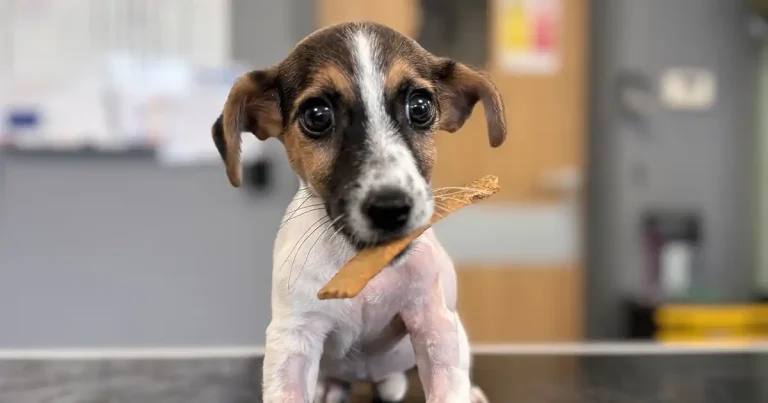
Eight-week-old Jack Russell terrier Deahling.
A vet has hailed the importance of contextualised care after her practice successfully performed two different lifesaving procedures on two puppies with the same heart condition in the same week.
Northern Ireland Veterinary Specialists (NiVS) in Hillsborough treated Deahling, an eight-week-old Jack Russell terrier, and nine-month-old crossbreed Peekaboo after they were both diagnosed with the heart defect patent ductus arteriosus (PDA).
Weighing just 1.2 kilograms, Deahling was too small for the advanced keyhole procedure usually used in such cases and required a complex, intricate open-chest surgery in which the abnormal blood vessel causing the condition had to be tied off by hand.
RCVS and European specialist in small animal surgery Joanna McCagherty, who performed the procedure, said: “She may be tiny, but she was incredibly brave. Her heart is now working normally – it’s a fantastic outcome.”
Peekaboo, weighing 2.6kg, was said to be just large enough for the keyhole PDA closure.
NiVS’ Julie Hamilton Elliott and Lumbry Park Veterinary Specialists’ Will Davis – both RCVS and European specialists in cardiology – performed the procedure, guiding a catheter into her heart via a blood vessel in her leg before deploying an Amplatz canine duct occluder device to seal the PDA.
Peekaboo was able to return home shortly after, and both puppies are said to be recovering well.

Dr Hamilton Elliott said: “The surgical management of PDA in dogs is inherently multifactorial, with decision-making shaped by patient-specific factors, the experience of the clinical team, access to appropriate facilities, and client factors, including financial constraints.
“As shown in this case, two dogs diagnosed with PDA in the same week were managed differently, taking into consideration their individual clinical needs and practical constraints. Despite these challenges, the successful and timely treatment of both patients highlights the effectiveness of contextualised care to deliver efficient, high-quality treatment.”
She concluded: “This is exactly why specialist care matters. Two puppies, two different procedures, two brilliant outcomes.”