
29 May 2026
Scholars suggested canine amputees be walked at a “comfortable middle speed” during postoperative rehabilitation.

Chris Simpson
Job Title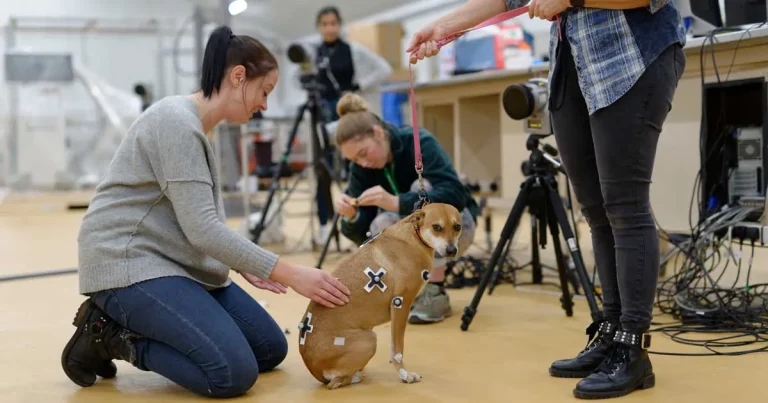
Tripawd research participant in RVC's Structure and Motion Laboratory. Image: RVC Structure and Motion Laboratory
Dogs with three legs may prefer walking at a more moderate pace rather than slowly, a new study has revealed.
Published in the Proceedings of the Royal Society, the paper saw RVC researchers analyse the gaits of canine amputees, offering fresh insight that may inform postoperative rehabilitation.
Scholars analysed 12 dogs of a range of sizes and breeds – six forelimb amputees and six hindlimb amputees – as they performed a range of trials at different speeds over a 10m distance using a 3D motion capture system and force plates at RVC’s Structure and Motion Laboratory.
In contrast to previous studies, the authors concluded “none of the [three-legged] gaits needs to be considered random”.
A total of 825 single limb stances were analysed from the force plate data.
For forelimb amputees, that consisted of 199 for the single forelimb, 113 for the hindlimb contralateral to the remaining forelimb and 117 for the ipsilateral hindlimb.
In hindlimb amputees, that consisted of 173 for the single hindlimb, 99 for the contralateral forelimb and 124 for the ipsilateral hindlimb.
The analysis revealed that forelimb amputee dogs place around 50% of their bodyweight through the single remaining forelimb, but weight distribution among hindlimb amputees was more even.
At higher movement speeds, the dogs used a gallop-like gait, while at lower speeds two strategies were observed; a slower version of the gallop or “uncoupled walking”, with the remaining pair of limbs moving in a walking pattern, while the single remaining limb contacted the ground more than once during each stride.
With the walk-like gait, the authors concluded: “It was apparent that this was not a preferred speed for any of the dogs and appeared laborious… Given that there were distinct alternative gait strategies at slow speeds, this could indicate that such speeds were uncomfortable, similar to those around the human walk–run transition speed.
“This was most apparent in the forelimb amputees. It is worth considering this during post-operative rehabilitation, and potentially not walking dogs too slowly, but aiming for a more comfortable middle speed.”
The scholars also posited their findings could help inform the development of adaptive legged robots.
Lead author Zoe Davies, former postdoctoral researcher at the RVC and current lecturer in veterinary sciences at Harper and Keele Veterinary School, said: “The focus of my postdoctoral research was in two-legged and four-legged locomotion, but I was inspired to look at three-legged locomotion when I started sharing an office with a canine amputee.
“The great thing about research is that you can often end up pursuing avenues you didn’t anticipate at the start.”