
15 Sept 2026
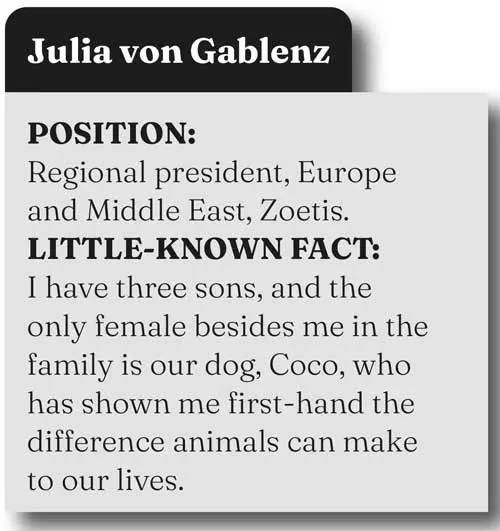
Julia von Gablenz, regional president for Europe and the Middle East at Zoetis, has more than two decades of leadership experience in human and animal health. It has been a fascinating career covering sales, marketing and strategy – to share some of her insights, we asked Julia to step into the Examination Room…

Vet Times
Job Title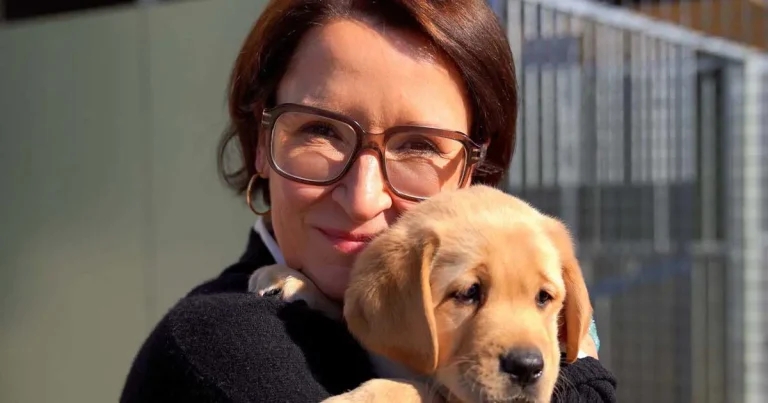
Q. Could you tell us about how you came to join Zoetis?
A. My route into Zoetis was through Pfizer Animal Health. I had already worked across human and animal health in Germany, in roles spanning sales, marketing and strategy. When Zoetis was created as an independent company in 2013, I became part of a business entirely focused on animal health.
Since then, my career has taken me from local commercial roles to leading global commercial development for dermatology, internal medicine and diagnostics in the US, and then back to Europe to lead our business in [Germany, Austria and Switzerland] and Central Europe before taking on my current role across Europe and the Middle East.
Q. What drew you to the veterinary and animal health industry?
A. What struck me when I moved into animal health was how directly it connects science with everyday life. A treatment can give a family more good years with a much-loved pet.
A vaccine can protect a flock, a farmer’s livelihood and the wider food supply. A diagnostic result can give a vet the confidence to act sooner.
It is a relatively close-knit industry, which also means you can stay close to the people using your innovations. You can sit down with veterinarians or farmers, understand what is making their work difficult and see the difference that a good solution makes.
That combination of science, human connection and tangible impact is what drew me to animal health and what has kept me here.
Q. What excites you about your role with Zoetis?
A. What excites me is that some of the problems veterinarians have lived with for many years are becoming scientifically addressable in new ways. We have already seen this in areas such as dermatology and osteoarthritis pain.
We are also seeing diagnostics move closer to the point of care, helping veterinary teams reach decisions more quickly and with greater confidence.
The opportunity looks different across our region. In some markets, the priority is expanding access to care. In others, it is helping stretched veterinary teams work more effectively or improving the management of chronic disease as pets live longer. For livestock customers, disease prevention, productivity, and food security remain critical.
The common thread is not innovation for its own sake; it is using science to solve a problem that matters and then ensuring that the solution works in the realities of everyday veterinary care.
Q. What are the biggest challenges you face in your role?
A. I lead a very diverse region, that has different needs. [Europe and the Middle East] is not one market.
A mature companion animal market may be dealing with workforce shortages and a growing population of older pets. A fast-growing market may be focused on improving access to care. Livestock customers may be navigating disease pressures, rising costs and food security concerns.
We cannot treat those situations as interchangeable, and we cannot pursue every good idea at once. My role is to listen, make choices and create enough clarity for our teams to act.
I am comfortable working with complexity, but I am also direct about priorities and trade-offs. Most importantly, I stay close to customers and colleagues. Decisions are usually better when you test your assumptions with the people working in practices, on farms and in local markets every day.
Q. What advice would you give people aspiring to leadership?
A. I would tell them not to wait until they feel completely ready. Some of the most important moves in my career took me into unfamiliar territory, from human to animal health, from Germany to the US, and between global strategy and operational leadership.
Leadership is not about having the perfect answer; it is about staying curious and asking questions, creating clarity when the answer is not obvious, making difficult choices and giving good people the trust and space to do their best work.
Raising my three sons while building my career also taught me that there is no sustainable version of high performance that ignores well-being. Be ambitious and strengthen your personality, but put your ego aside. Ask for help, learn from setbacks and invest in your team.
In the end, your leadership is reflected less in your title and more in what the people around you can achieve.
Q. Where do you see the greatest unmet needs in vet care?
A. Longer lives are a wonderful development, but they also mean that chronic and age-related conditions are becoming a much larger part of veterinary medicine.
Chronic kidney disease is one of the clearest examples. It is common in older cats, affects dogs and can be difficult to identify early because the initial signs may be subtle.
Once diagnosed, care is largely centred on dietary and supportive measures to control clinical signs, address complications and maintain quality of life.
Veterinary teams do an excellent job with the tools available, but the burden on the animal, the owner and the practice can still be considerable. That should challenge our industry. We need better ways to detect kidney disease earlier, understand the pathophysiology and intervene more effectively.

Q. How does new science translate into better care?
A. A scientific breakthrough is only the beginning. We have seen monoclonal antibodies open new possibilities in veterinary medicine by targeting specific biological pathways, including in areas such as allergic disease and osteoarthritis pain. Their wider significance is that they have expanded our sense of which long-standing veterinary problems might be addressable.
But novelty alone is not enough. Veterinarians need robust evidence, a clear understanding of where an innovation fits and confidence discussing it with animal owners. We also need to think about diagnosis, treatment and monitoring as a connected pathway – particularly for complex chronic diseases.
Finally, innovation has to reflect the realities of the consultation room. Time is limited, owners need clear guidance and some animals – particularly cats – can be difficult to medicate. It also has to work across different patients, owners, and practice settings.
The goal should always be to make a difficult condition more manageable and give veterinary teams better options than they have today.
Q. When you look at Zoetis’ pipeline, what makes you most optimistic?
A. What makes me optimistic is not simply the number of potential innovations in development, but the problems we are aiming to address, where veterinarians have had limited options, including chronic kidney disease, oncology and cardiology.
We are also able to bring together different capabilities, from monoclonal antibodies and advanced diagnostics to data science, rather than viewing treatment, detection and monitoring as separate challenges.
The direction for the future is clear: we want to help veterinary teams detect disease earlier, prevent and intervene more precisely, and manage complex conditions more effectively.
If we get that right, the next wave of innovation will not simply add more tools, it will expand what veterinarians believe is possible for their patients.