
4 Aug 2026
Vet Fraser Reddick warned lungworm is present throughout the UK after a dog’s infection became a life-threatening emergency.

Chris Simpson
Job Title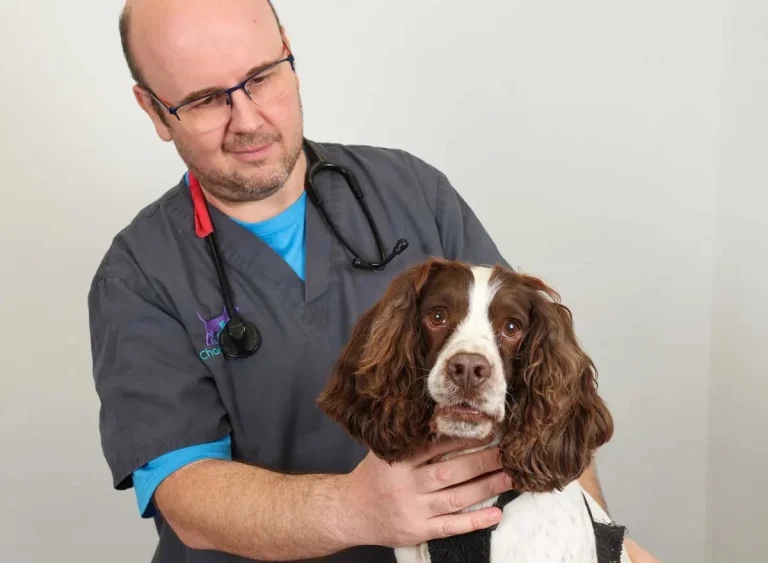
Quentin and vet Fraser Reddick, who saved his life.
A vet has issued a warning to pet owners to keep worming treatment up to date after saving the life of a dog with a severe lungworm infection.
Seven-year-old sprocker spaniel Quentin was taken to Chantry Vets’ hospital in Wakefield, West Yorkshire, after a persistent cough worsened to the point of coughing up blood.
What was initially suspected to be a grass seed lodged in his lungs was found to be lungworm, confirmed by diagnostics tests after a CT scan revealed widespread bleeding throughout his lungs but no foreign body.
Quentin was placed in intensive care due to the severity of the infection.
Alongside treatment to eliminate the lungworms, he received a blood transfusion from one of the practice team’s own dogs to replace clotting factors and platelets, medication to help control the bleeding and steroids to reduce inflammation and minimise reactions as the parasites were killed.
The dog eventually stabilised as the team determined he could breathe without intensive support and went on to make a “remarkable” recovery.
Clinical director Fraser Reddick, who led Quentin’s treatment, said: “Quentin was an incredibly sick dog and there was a point where we genuinely didn’t know whether he would survive.
“Cases like this require rapid diagnosis, advanced imaging, intensive nursing care and a huge team effort.
“Our in-house CT facilities, experienced clinicians and dedicated night team all played a vital role in giving Quentin the best possible chance.”
Mr Reddick added that while lungworm was once considered mainly a problem in the south of England and Wales, it is now found throughout the UK.
He continued: “Although we don’t see large numbers of cases locally, Quentin’s experience shows it is present in our area and that every dog could potentially be at risk.
“The good news is that lungworm is largely avoidable. Using an appropriate preventative worming treatment, as recommended by your veterinary practice, is the best way to protect your dog from this potentially fatal disease.”