
26 Aug 2026
Treated mice showed improved gait characteristics and greater ability to complete treadmill exercise tests, alongside reduced weight gain and lower levels of OA biomarkers in the blood.

Chris Simpson
Job Title
AI image of osteoarthritis. Image: Generated by RVC using Gemini
Researchers have identified a “hugely exciting” potential treatment for osteoarthritis (OA) in both humans and animals.
Scholars from the RVC, University of Oxford, Middlesex University and the Institute of Cancer Research (ICR) identified cyclin-dependent kinase 8/19 (CDK8/19) – closely related proteins that control how cells make other proteins – as a mediator and drug target in OA disease cell models.
It is said the paper’s findings provide a potential first-of-its-kind disease-modifying strategy that could improve how OA is managed across multiple species.
The team tested a CDK8/19 inhibitor in STR/Ort mice – which spontaneously develop OA that increases in severity with age, closely resembling primary OA in humans – to assess its impact on joint health and mobility.
They found it reduced inflammatory processes, corrected gait asymmetry and improved treadmill completion rates while suppressing weight gain and OA biomarker levels in the blood.
Treated mice were said to have appeared alert and active in addition to being well-groomed, while untreated control mice were less mobile, larger in size and often piloerect.
Histological analysis of the treated mouse knee joints also revealed improvements in cartilage composition.
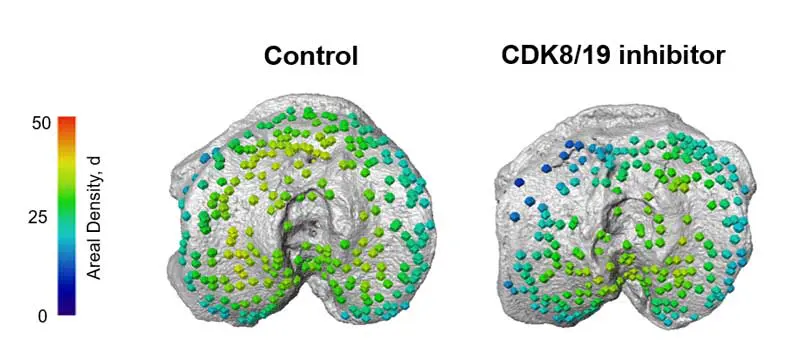
Micro-computed tomography – which creates a detailed 3D representation of the joint – showed CDK8/19-inhibitor treatment also affected bone/cartilage changes linked to OA by limiting the number and density of mineralised growth plate “bridges”, which otherwise accumulate with age in STR/Ort mice in more severely affected OA joints, compared with untreated mice.
The treatment’s impact on the growth plate matrix was described in the paper as “perhaps the most striking observation” in the study.
Overall, the researchers found treatment of the mice for 12 weeks promoted “a dramatic improvement in body condition and movement”.
Co-author Scott Roberts, reader in translational skeletal research at the RVC, said: “This research provides a fundamental understanding of the mechanisms by which cells become disease-causing in osteoarthritis and, importantly, provides a pharmaceutical option for disease reversal.
“This is hugely exciting and impactful given the absence of any disease modifying osteoarthritis drugs.
“The next stage of this project is to transition the research from preclinical into proof-of-concept studies to show disease modifying efficacy in a patient population.”