
23 Apr 2026
Imaging technology “significantly improves the management of patients” at high risk of tumour spread.

Chris Simpson
Job Title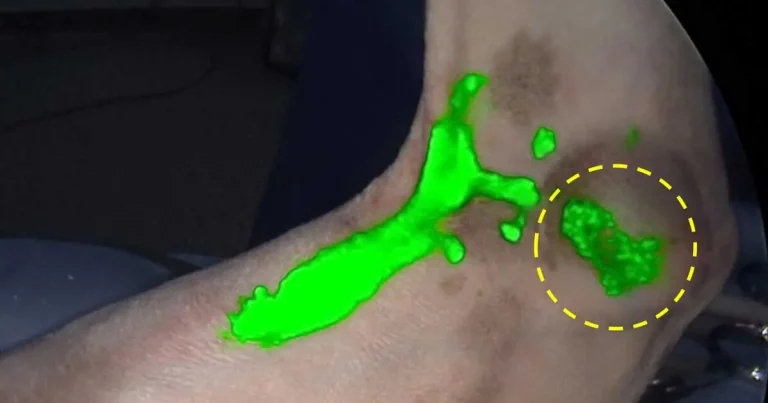
Dogs’ front leg with its tumour shown within the yellow circle. A harmless dye that illuminates under a near infra-red light, identifies the lymphatic pathways and nodes that the tumour drains to. Surgeons can then remove the lymph nodes that may be affected by cancer spread.
Vets from the University of Edinburgh’s Hospital for Small Animals have hailed new imaging technology that can help track the spread of cancer in cats and dogs.
Near-infrared fluorescence (NIRF) imaging enables veterinary surgeons to visualise lymphatic drainage pathways from tumours by tracking fluorescent dye, aiding accurate identification of tumour spread to lymph nodes.
The dye, most commonly indocyanine green, is injected at the site of a tumour or tumour scar and can be followed to the sentinel node, said to be the first to drain a primary tumour and therefore expected to be the first site to harbour metastases.
Relevant nodes fluoresce with the NIRF camera system, enabling real-time localisation and targeted dissection for removal.
Removal of metastatic nodes can contribute to tumour control, and it is said that verifying whether the sentinel node is positive or negative for tumour spread can significantly influence prognosis, treatment recommendations and overall case planning.
RCVS specialist in soft tissue surgery Kathryn Pratschke said: “We are delighted to have this technology available, that allows us to work with our colleagues in oncology to strengthen the accuracy of staging and support tailored oncology decision-making.
“This will improve outcomes for patients referred to us for treatment of cancer.”
The hospital’s head of oncology, Laura Blackwood, added: “Having NIRF available significantly improves the management of patients with tumours with high risk of lymph node spread. It’s great to have it available for our patients.”
Ongoing research is said to suggest NIRF technology may have additional applications in the future, in chylothorax surgery, surgery for biliary tract obstruction, and identifying blood supply to skin for reconstructive surgery.