27 Feb 2026
Cambridge Students’ Union described the decision-making process as ‘catastrophic’ while university staff said it had caused ‘unprecedented’ stress.

Chris Simpson
Job Title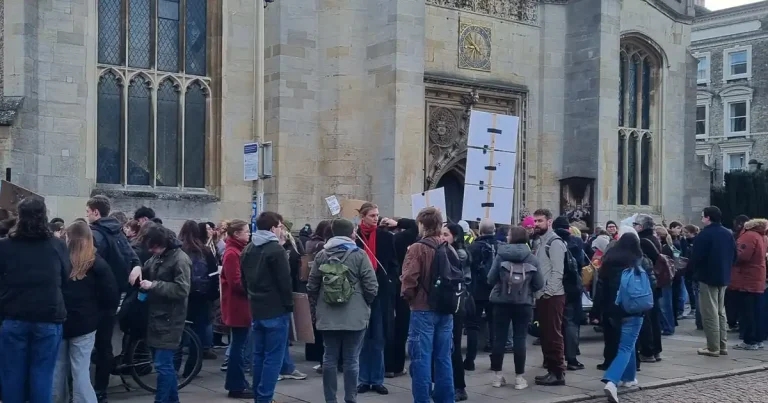
Protestors outside a crucial meeting on the future of the University of Cambridge vet school on 23 February 2026.
University of Cambridge officials have faced calls to resign over their handling of the process that almost led to the closure of its vet school.
The school was ultimately spared on 23 February by the university’s general board following the Council of the School of Biological Sciences’ recommendation that it closes back in December, which the Department of Veterinary Medicine (DVM) had described as a “bolt from the blue”.
Cambridge Students’ Union welcomed “the sensible and reasonable decision” to not close, but slammed the process for being “fundamentally flawed” and putting “enormous unnecessary pressure on vet students and staff”.
The union said: “We believe students and staff deserve to see people held to account for the catastrophic way this has been handled up to this point.
“While our attention is focused on supporting and protecting our vet students, it mustn’t be forgotten who caused this.
“Those members of the university administration that have enabled and encouraged these failures must now consider their positions.”
Critics argued the process lacked transparency and failed to hold proper consultation with staff and students.
Speaking at a demonstration outside the meeting on 23 February where the school’s fate was decided, associate professor of equine orthopaedic surgery Merry Smith accused the university of “riding roughshod over the procedures that are in place if a department should need some form of revision or appraisal”, describing it as “the most enormous insult”.
In a statement, the DVM said it was “pleased and heartened” by the decision, and looked forward to working with the university, general board and School of the Biological Sciences “in a collaborative manner”.
But it said staff and students had been subjected to “an unprecedented amount of stress and worry”, adding: “We sincerely hope that the university takes note of the multiple concerns raised about this process and the lack of transparency leading up to this outcome.
“We would not wish our colleagues in other departments to endure the same experience that our staff and students have been through.”
Jayson Hughes, president of The Association of Veterinary Students, called for “a formal and independent review of how the proposal was managed”.
He said: “There have been calls in some quarters for resignations. We understand why emotions are running high. However, our view is that the priority should be establishing clear accountability.”
Staff and students were informed of the decision in a town hall meeting ahead of the university releasing a statement.
Fifth-year student and Cambridge University Veterinary Society member Shreya Patel said: “I think all students and staff left that meeting still feeling this internal sense of angst that due process wasn’t followed, because it doesn’t exist.
“It feels to us that steps were taken to avoid following a due process, and any attempts to request an apology, request a formal review, were denied or evaded. That is very concerning for us.”
She added: “A lot of us are still dealing with the effects of long-term burnout and stress from this situation, and it’s impacted our education.”
The British Veterinary Union also said it was “disappointed” by the handling of the process and would be supporting calls for a formal review.
In the statement announcing the vet school’s future, a university spokesperson said the general board “recognises that the School of the Biological Sciences cannot be solely responsible for the future of veterinary education” at Cambridge and that “further analysis, supported by external experts, is required to develop and evaluate alternative models”.
In response to the resignation calls, the university said it did not have anything to add to its statement.