
24 Feb 2026
Graham Duncanson, FRCVS recalls September’s second European South American Camelid Congress, hosted by the British Veterinary Camelid Society in Cambridge.

Graham Duncanson
Job Title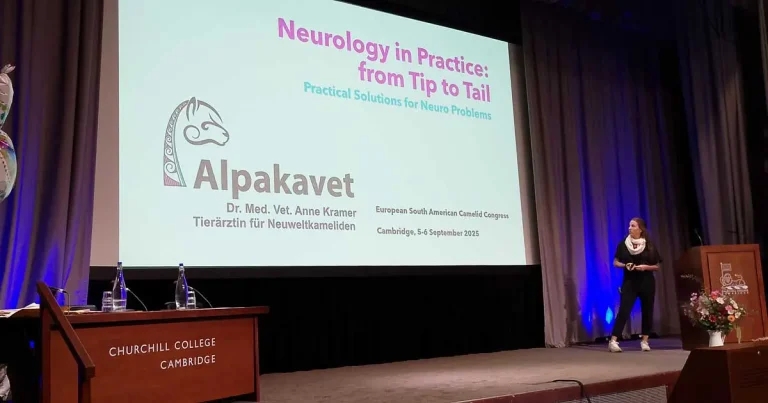
The second European South-American Camelid Congress follows the first one in Vienna in December 2023.
Hosted by the British Veterinary Camelid Society, this latest event was held in Churchill College, Cambridge, on 5 to 6 September 2025. The accommodation, food and facilities were top flight. I expect that they were appreciated by the large number of delegates, two-thirds of whom where from outside of the UK and representing 13 countries. The organising committee – especially its chairperson, Karin Mueller – must be congratulated on their superb organisation.
The congress is primarily aimed at practitioners, both those with considerable experience with South American camelids and those who come across these interesting animals on occasions in the course of their daily work.
It was fitting that Christine Magrath gave the first excellent keynote lecture, “Getting your message across – client communication”. However knowledgeable you are as a practitioner, unless you can bring your clients on board, you are unlikely to be very successful. Modern veterinary practice in Europe and the UK has to focus on welfare and prevention of disease, so the second keynote lecture on herd health plans given by Henrik Wagner from Germany was a very sound place to start from the view of clinical practice.
Henrik had many useful ideas for strengthening the practitioner-client bond. The common use of camelids for human-centred activities (such as trekking or special events) across Europe raises particular welfare considerations, and the work on human-alpaca interaction by Monika Budzyńska and Joanna Kapustka from Lublin University of Technology, Poland, is very timely.
I thought that Karin Mueller’s clever blending of keynote speakers and short oral presenters was sensible. Naturally, delegates were encouraged to read the poster presentations in the coffee breaks. In addition to the short oral presentations, there were several short refresher lectures given by experts in their field such as Elly Po, a clinician at the University of Cambridge’s vet school, who reviewed the fundamentals of nutrition and supplements on the first morning, as well as examination, triage and sedation on day two.
I found the two short presentations – one on ultrasonography by Thomas Wittek from Vienna and another on integration of camelids in an experimental facility by Ulrike Teichmann from Germany – very refreshing in the second part of the morning session on the first day.
After an early lunch, we were given some very useful learning on dermatology by Claire Whitehead, an RCVS specialist in camelid health and production, alongside Eva-Maria Bartl on specific dermatological examination, before turning to performing a neurological work-up by keynote speaker Anne Kramer, who is originally from the Netherlands, but now working in her own camelid practice in Switzerland.
Our neurological learning continued with three short presentations from Germany’s Viktoria Balasopoulou and Johann Maierl (presenting Nils Mutschler’s work) and Austria’s Kathleen Wittek.
After the tea break, we had a super keynote lecture from Sonja Jeckel (RVC) on performing field postmortems on camelids, which are a particularly taxing problem in the UK on account of the incidence of bovine TB. The learning on infectious diseases in camelids continued with five short oral presentations from Lisa Ulrich (Germany), Carmen Luginbühl (Switzerland), David Jorge (APHA, UK), Elisa Castalldo (Italy) and Walter Basso (Switzerland).
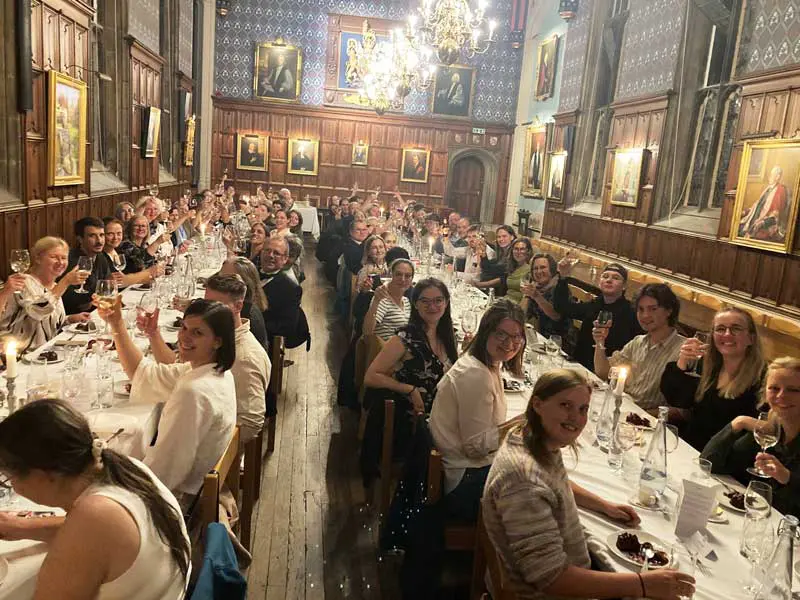
I only had time for a very quick shower before, what was for me the highlight of the congress, an evening walk through beautiful historic Cambridge to a spectacular dinner at Corpus Christi College.
The second day kicked off with a very amusing and informative keynote lecture from my long-term friend, David Williams, on the fundamentals of ophthalmology in camelids. This was complemented by anatomical insights and a clinical case by Johann Maierl (presenting Sophia Weis’s work) and Carmen Luginbühl. Thomas Wittek then educated us on the veterinary examination of camelids for breed registry and pre-purchase assessment.
After the break, Elly Po set the scene with fundamentals of clinical examination and triage, before Sonja Franz from Vienna gave us her fascinating keynote lecture, entitled, “From symptom to diagnosis”. Katja Voigt completed the morning session with a short presentation on health problems in SACs in southern Germany.
A quick appetising lunch took us to a keynote lecture on camelid fleece by Mary-Jo Smith, originally from Canada but for the last 25 years working in the UK. Then, we had another keynote lecture from Jane Vaughan from Australia, who is no stranger to camelid vets in the UK, on, “Reproductive management and assessment of the male”. She gave us a marvellous template for efficient breeding management in camelid herds.
As a practitioner, I really enjoyed Claire Whitehead’s fundamentals of dystocia with helpful hints. Justine Clinquart from Belgium gave us another useful insight on disease predictors in neonatal crias before the tea break.
The next theme was termed “therapeutics”, but it had very wide coverage from Elly Po on sedation, Cassandra Eibl (Austria) on anaesthesia and Claire Whitehead on therapeutic fundamentals. It once again was very useful for me as practitioner.
Emerging and exotic disease are constantly in our thoughts as veterinarians, so David Jorge and Henrik Wagner were very interesting in their final lectures. Obviously, bluetongue virus was at the top of the list, including clinical presentation seen in German alpacas and llamas. Their lectures included a large amount of up-to-date information which was of considerable interest to the audience.
Best poster presentation went to Camille Coene (Belgium) for her case report of oleander poisoning in an alpaca herd, with runner up Emily Hewett (UK) for her study into correlation between PCV and assessment of mucous membrane colour. No congress would be complete without some discussion on the way forward for the profession. Karin Mueller and Henrik Wagner’s bold ideas for a pan-European disease data base, and “combined voice” owner education, were welcomed by all the delegates.
There was no doubt that this meeting had radically increased the number of opportunities for further client education. I was also delighted with the decision to hold another congress in two years, this time in northern Italy.
Graham Duncanson has been a veterinary surgeon for 59 years and has had a great life working all over the world. He has two children of whom he is immensely proud, and they have picked two partners who he finds good fun and very interesting. Graham has three grandchildren who he finds exhausting, but delightful. He goes walking every day. His four hobbies are watching rugby, soccer and athletics, writing textbooks and fiction, and travelling and attending veterinary clinical meetings.