5 Aug 2026
Mathematicians and scientists united to refine charity’s Donkey Risk Index tool.

Chris Simpson
Job Title
Donkeys at The Donkey Sanctuary.
A group of Europe’s leading mathematicians and scientists have partnered with a leading international animal welfare charity to apply their problem-solving skills to some of its biggest challenges.
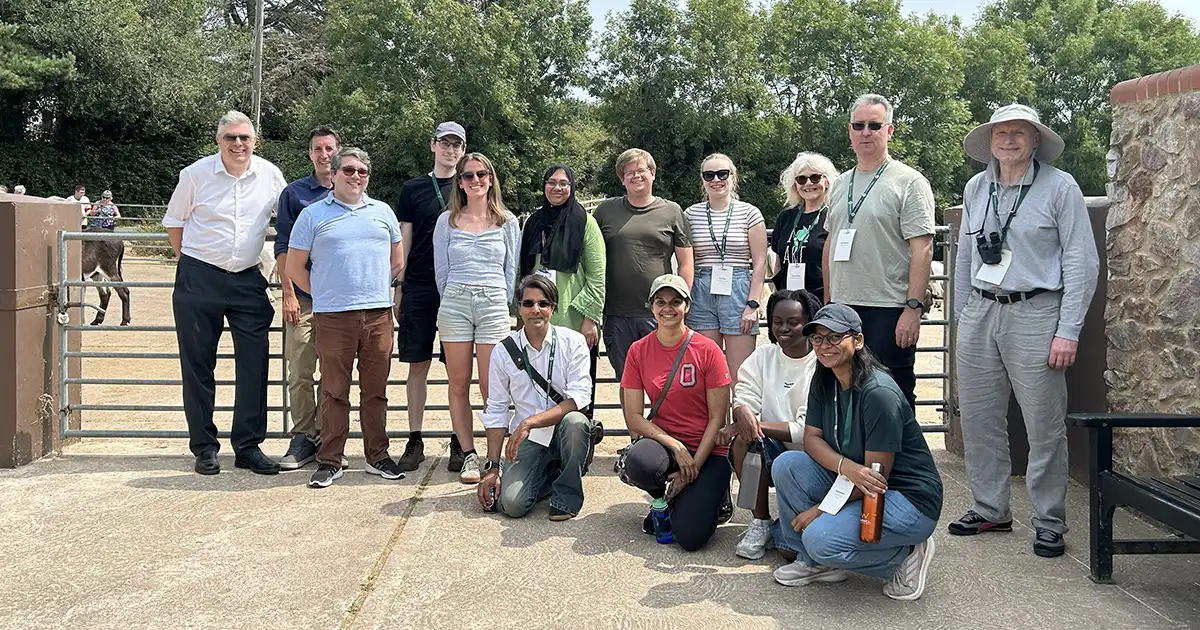
Mathematicians, statisticians and data scientists headed to The Donkey Sanctuary’s Devon headquarters in July for a week-long workshop as part of the 195th European Study Group with Industry (ESGI) at the University of Exeter.
They were challenged to strengthen the charity’s Donkey Risk Index (DRI), a tool that identifies where donkeys are most at risk and where support can have the greatest impact, particularly in regions where reliable data is limited.
Working with existing datasets and potential new indicators, the group tested assumptions behind the DRI, evaluated additional measures of risk and investigated new ways of predicting how welfare risks may change over time and across different regions.
The group aimed to make the index more robust, helping the charity identify emerging trends, better understand the drivers of welfare risks and support more effective planning, reporting and targeted interventions.
The Donkey Sanctuary’s data analytics manager, Alex McKenna, said: “As a charity we welcome collaboration and partnerships, and this was a brilliant opportunity to work with some of the best minds in maths, science and data to find new and improved ways of helping donkeys wherever they are in the world.”
Stefan Siegert, from the University of Exeter, added: “When people think of mathematics, donkeys aren’t usually the first thing that springs to mind – but that’s what makes the ESGI Study Group conference so much fun.
“Our team was excited to get stuck into further development of the charity’s Donkey Risk Index, applying the same kind of modelling used in public health and environmental science to a completely different (and very lovable) subject.
“It’s the sort of quirky, real-world problem that mathematicians thrive on.”
The ESGI unites experts with partners from business, industry and government to solve their mathematical or computational problems.
The 195th edition also included challenges to monitor and quantify carbon capture from regreening efforts in a nature reserve and helping to create accessible sound-based tools for use by vision-impaired mathematicians and data scientists.