
30 Jun 2026
Petra Agthe CertVDI DipECVDI MRCVS discusses why speaking up still feels risky despite research showing it can help patients and the sector is encouraged to do so.

Petra Agthe
Job Title
Image: Halfpoint/ Adobe Stock
Psychological safety has become an increasingly familiar concept in veterinary medicine. It appears in conversations about patient safety, leadership and culture, and staff well-being, and is positioned as something we should all be striving for.
The evidence supporting psychological safety is indeed compelling: teams with higher psychological safety tend to communicate more effectively, make fewer errors, are more likely to learn and adapt better in complex environments, and report greater well-being (Edmondson, 2018).
And yet, despite this growing awareness, many veterinary professionals will recognise a persistent gap between theory and reality. We know psychological safety matters. But how exactly does it look in practice? What do we need to do or say to cultivate psychological safety? Why do some people in the same team feel psychologically safe while others don’t? And how is it that speaking up can still feel risky even when evidence shows us that it helps our patients and we are encouraged to do so?
These questions are worth paying attention to, because psychological safety is not simply about awareness and intention.
Psychological safety is complex and shaped by many factors, including behaviours, beliefs, experiences of individuals, by the accumulation of small interpersonal interactions, but also by the everyday working realities of teams such as wider organisational and professional culture, power and hierarchy, workplace design and workload management (Edmondson 2018; Ito 2022; Dong 2024).
Increasingly, it is also clear that we cannot talk about psychological safety without considering topics such as incivility, microaggressions, burnout and other occupational mental health challenges, as well as neurodiversity (O’Dare, 2024; Loh, 2021; Desai, 2023; Knobel, 2025). These are not separate issues. They are deeply interconnected, and together they shape the conditions in which people either speak up or stay silent.
Psychological safety is often misunderstood as a synonym for kindness or niceness. While kind and respectful behaviour is important, this framing risks oversimplifying what is actually a far more demanding and, at times, uncomfortable concept.
Amy Edmondson, who is the most prolific researcher in the field of psychological safety, defines the concept as the “shared belief held by members of a team that the team is safe for interpersonal risk taking” (Edmondson, 1999).
More specifically, individuals who feel psychologically safe feel that they can share their concerns and ideas, ask questions or admit mistakes without worrying about embarrassment, humiliation, retribution or being ignored or blamed. They are confident these acts of vulnerability and candour are appreciated, and they trust and respect their colleagues.
This means that psychological safety is a team concept where team members collectively believe that sharing their perspectives, experiences and doubts in an open and honest way is explicitly welcome.
In the context of veterinary practice, that risk-taking might involve questioning a clinical decision, admitting uncertainty, raising a concern about patient care, disclosing a mistake we have made or a personal challenge, suggesting changes to the work environment that make work easier and/or safer, or simply asking for help in a busy moment.
These are not trivial acts. They require a willingness to be vulnerable in front of colleagues, often in situations where there is time pressure, hierarchy and ambiguity.
Psychological safety exists when people believe that this vulnerability will not be met with ridicule, indifference, dismissal or punishment, but with kindness, curiosity and respect. It is not about creating a comfortable environment where difficult conversations are avoided.
On the contrary, it is about creating an environment where those conversations can happen with honesty — and where they are handled in a way that preserves trust and learning.
One of the reasons psychological safety is so critical lies in how humans respond to perceived threat. Safety is one of the most fundamental human needs. When we feel safe, we are able to think clearly, solve problems and collaborate effectively. When we feel threatened on the other hand — whether by overt conflict or more subtle social cues — cognitive capacity narrows (Edmondson, 2018).
The brain prioritises self-protection over exploration and communication, because the potential personal risk is immediate and high, whereas the benefits that speaking up creates for the team or wider organisation occurs with a time delay and is less certain (Figure 1).
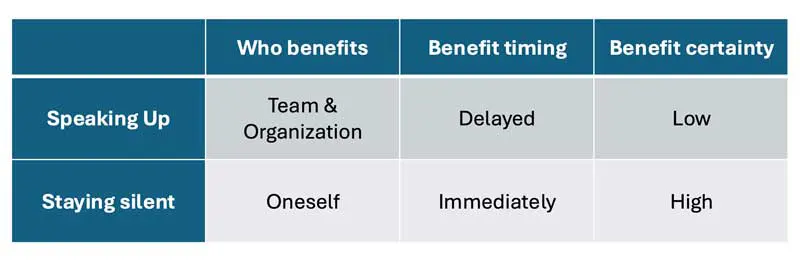
In a veterinary setting, this can have immediate consequences for patient safety. When a team member finds it difficult to think clearly or ask for help, for example when trying to make an important clinical decision, when trying to perform a difficult procedure for the first time, or when handling a challenging interpersonal situation, patient safety is at risk.
Furthermore, a valuable learning opportunity for the entire team may be lost. That hesitation is not a lack of knowledge or professionalism. It is a predictable human response to perceived interpersonal risk. In this sense, psychological safety is not just a cultural ideal. It is a practical requirement for safe clinical practice in a veterinary team.
Incivility is usually defined as disrespectful or rude behaviour. It is important to note that incivility can have a subjective component. While there are some behaviours that are likely to be perceived as uncivil by most people, others are more ambiguous.
Furthermore, whether a behaviour is perceived as uncivil can be influenced by culture, and individual communication preferences (Meyer, 2014; Knobel 2025). Research has also shown that a range of other factors may give rise to incivility, such as high workload and leadership behaviours (Keller, 2020) and burnout (Loh, 2021).
Clearly, consideration of system factors such as work pressures and a nuanced and compassionate approach towards communication challenges in the workplace are therefore highly important.
At the same time and regardless of intention, incivility can have a major impact on psychological safety.
Small behaviours such as interrupting, dismissing ideas, using sarcasm under pressure or failing to acknowledge contributions can have an effect on how safe people feel. These moments may pass quickly, but are often not easily forgotten.
As mentioned, they contribute to prioritisation of self-preservation and reduced cognitive bandwidth, regardless of whether someone is the direct target or witness of uncivil behaviour. Its effects may influence the ability to focus, decision-making as well as team cohesion.
Over time, these experiences may shape expectations about what will happen if someone chooses to speak up.
In a profession where early intervention can make the difference between a near miss and a serious incident, that silence clearly matters.
Another important but often overlooked facet of communication challenges that may result in reduced psychological safety are microaggressions. These are subtle, derogatory or dismissive behaviours or messages towards members of marginalised groups.
Microaggressions are often unintended, and yet they can have a significant impact. A comment framed as humour, a well-intended but intrusive question or an uninformed assumption based on stereotypes may seem minor in isolation. But over time, they accumulate. This accumulation has been described as “death by a thousand cuts,” and its impact on psychological safety and mental health is increasingly understood (Desai, 2023). Repeated exposure to these small stressors can create a chronic sense of unease, and may have a great impact on confidence and learning experience.
Incivility and microaggressions are not trivial issues, as they not only come at great cost to individuals who are affected by these behaviours. Evidence shows that in complex environments (which is undoubtedly the case for veterinary workplaces), diverse teams tend to outperform homogeneous ones (Knobel, 2025) – but only when psychological safety is high and individuals, regardless of their backgrounds, feel safe to engage in interpersonal risk taking.
A key aspect of psychological safety is that it may not be experienced equally by everyone, because, quite simply, the risk is not equally distributed. These factors may impact whose voices are heard, whose are overlooked and who feels able to challenge the status quo. For example, for a senior clinician, speaking up may carry relatively little interpersonal risk. For a new graduate, patient care assistant or student nurse, the same action may feel far more consequential. Similarly, there is evidence that people who have recently started a new position, tend to experience a drop in psychological safety (Bransby, 2024), which is significant in veterinary work environments where staff turnover may be high.
Furthermore, while formal hierarchy plays a role, there are also other forms of power including knowledge and experience, as well as social privilege and influence. With all other things being equal, the risk of speaking up can be higher for people from marginalised backgrounds. This may be compounded by previous experiences, particularly those involving criticism or exclusion, which can further amplify the perceived risk. When certain voices are consistently absent from discussions, it is worth asking why. Silence is rarely random. It often reflects an underlying calculation about what feels safe.
Veterinary medicine has long been shaped by a culture of high standards, resilience and professionalism. These are important values, but they can also create unintended barriers.
Expectations of perfection and invulnerability can make it difficult to admit uncertainty or acknowledge mistakes. If vulnerability is perceived as weakness, then speaking up may become inherently risky.
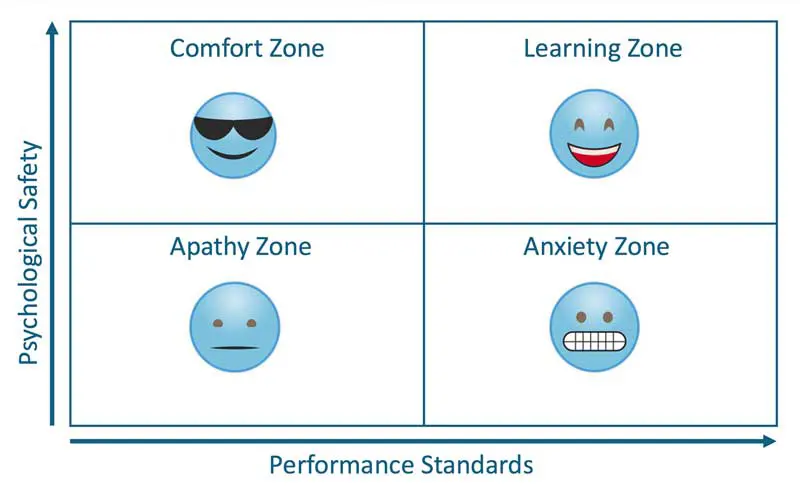
Psychological safety offers an alternative framing. It invites intentional and voluntary vulnerability in the service of creating conditions where errors can be identified and addressed early, and where learning is prioritised over blame.
In this sense, psychological safety is not about lowering standards or letting go of accountability. It about facilitating learning in a high stakes environment by making it an explicit, collaborative and mutually supportive experience (Figure 2).
It is tempting to view psychological safety as the responsibility of leaders alone. And while leaders are certainly hugely influential in shaping the work environment, they need psychological safety as well. Therefore, psychological safety is created in everybody’s small, everyday interactions that occur within a team.
How we respond when someone asks a question. Whether we acknowledge contributions. How we behave under pressure. How we show that others matter and how they matter. Whether we are welcoming those with whom we may have less in common.
Some of these moments may seem minor, but they accumulate, shaping the environment others experience. A single dismissive response can discourage future input. Equally, a moment of curiosity or encouragement can make it easier for someone to speak next time. This does not require perfection, but it requires awareness, intention and a willingness to reflect on the impact of our behaviour on others.
There is no simple solution to building psychological safety. It is not something that can be achieved through a single intervention or training session. It requires an ongoing, systemic approach that considers not only individual behaviour, but also additional factors such as workload, communication patterns, team structures, psychosocial hazards and wider organisational and professional cultures.
What is clear, is that psychological safety cannot be separated from the broader context in which people are working. If we want to create safer, more effective veterinary teams, we need to move beyond encouraging individuals to be more confident, civil and resilient. Instead, we need to ask a different question: what is it about our environment that makes speaking up feel risky — and what can we do to change that?
Because ultimately, psychological safety is not about eliminating discomfort. It is about ensuring safety in the discomfort of taking interpersonal risks, so that people feel able to speak, to question and to contribute without fear. This is not a luxury. It is a fundamental part of safe, sustainable veterinary practice.
Petra Agthe is a European specialist in veterinary diagnostic imaging with nearly 30 years of experience in first-opinion and referral practice, as well as leadership experience. Alongside her main job, she has also qualified as a coach and certified mindfulness practitioner. Petra is a passionate human factors advocate with a particular interest in psychological safety, communication and human-focused leadership in veterinary medicine. She is also co-founder and host of the Vet Mind Works podcast. Petra also engages in freelance work as a speaker, workshop facilitator and as an associate trainer for VetLed.