
20 Jan 2026
Nigel Dougherty BA (Zoology), BVSc, MVSc (Wildlife Health), MANZCVS (Zoo Animal Medicine), NZCert (Emergency Care) explains the unifying of the three acid-base approaches to characterise the acid-base disorder in the second of this two-part series (first part in VT55.41)

Nigel Dougherty
Job Title
Image: Supapich / Adobe Stock
Three approaches treat pCO2 the same. Thankfully, the different approaches only appear to “differ” in the way the metabolic component is managed.
In reality, the same fundamental core influences are measured by each of the different approaches, because all of the approaches are derived from the same thermodynamic equilibrium equations.
The unification of the different approaches, in terms of equivalence, has been summarised by Kellum (2005).
The link between the various electrolytes and pH (hydrogen ion concentration) is summarised in “Gamblegrams”, which was developed by physiologist James Gamble. To help conceptualise, in the Stewart approach, bicarbonate levels can be thought of as being “squeezed out” under acidotic conditions by one or a combination of elevations in weak acids, reduction in strong ion difference (SID), or increasing unmeasured anions.
How does the body normally maintain different pH values in adjacent fluid compartments, which are separated by a membrane? Applying Stewart’s theory of acid-base equilibrium, one of the three independent variables that determine [H+] must be manipulated by the body.
Carbon dioxide diffuses freely across all membranes in the body, rendering it of little use in pH management across compartments (obviously, other than through its loss from the body via the lungs, carbon dioxide, together with buffers, are the two main players limiting major oscillations in pH). Proteins do not freely cross intact biological membranes, making them ineffective candidates for control.
Phosphate is regulated by mechanisms in the gut and kidneys to maintain calcium homeostasis within fine critical limits, rather than primarily for acid-base regulation. Consequently, the management of SID is considered the mechanism for generating pH differences in adjacent compartments (Morgan, 2009).
For acid-base purposes, the kidneys (with the liver creating appropriate metabolic precursors) are the most important regulators of SID (although other organs such as the gut and the skin may play important roles in certain circumstances; for example, in equine sweat glands).
The concentration of strong ions in plasma can be altered by adjusting their absorption from glomerular filtrate or secretion into the tubular lumen from plasma. However, plasma [Na+] is used in the control of intravascular volume (as the polar water molecule follows sodium) and plasma [K+] requires close control to ensure appropriate electro-potential difference to support neuromuscular and cardiac function. Therefore, chloride is the most important strong ion that the kidney uses to regulate acid-base status without interfering with other important homeostatic processes, because through its excretion or conservation, bicarbonate can be excreted or conserved; for example, in the compensation for a respiratory acidosis, the excretion of H+ in the urine is in itself not important (and is not possible alone, because of electroneutrality).
Instead, the removal of Cl– in the urine (as opposed to its resorption back into plasma) will increase the value of the SID in plasma and, therefore, help return plasma pH towards normal.
The importance of ammonia (which is formed from glutamate, showing the importance of the liver in its generation) when using Stewart’s approach is that the weak ammonium cation allows the urinary excretion of the chloride anion without loss of any strong cations (Kellum, 2000; Weiner and Verlander, 2017).
Excretion or resorption of additional chloride by renal tubular cells will alter the plasma SID and, therefore, effect plasma pH.
The traditional approach is done by reference to pH, bicarbonate, carbon-dioxide and anion gap (and by accommodating for compensation).
In the semi-quantitative approach, with the standard base excess (SBE) as a measure of the change in SID from equilibrium (the point at which pCO2 equals 40mmol/L and pH equals 7.4) and the anion gap corrected for the patient’s A-, it is possible to characterise the metabolic disorder.
Without such elaborate base-excess partitioning methods, mixed acid–base disorders would not otherwise be detected by the measurement of SBE alone (Morgan, 2011; 2009).
In the quantitative approach, the nature of the metabolic disorder can be characterised by quantifying apparent SID (termed SIDa), A- and strong ion gap (SIG). All these are measured in mmol/L.
Processes that primarily lower disparity between sodium and chloride are equivocal to normal anion gap or chloraemic metabolic acid-base influences, and are reflected by changes in SIDa. Alterations in the levels of unmeasured ions (as estimated by SIG) are equivocal to the high or low anion-gap group of metabolic acid-base alterations (Artero, 2017).

Now that we know what our patient’s normal parameters should be, the next step is to categorise the patient’s acid-base status. Always remember, though, that a normal pH does not necessarily imply a normal acid-base status, because disturbances to acid-base status can be simple or complex (latterly also referred to as “mixed”).
In simple disturbances, essentially only one process – the primary disturbance (together with its accompanying compensatory response) – is influencing the pH to make pH deviate from normal. In complex (mixed) disorders, more than one primary process is influencing pH.
Several ways exist to determine if laboratory values are consistent with a single acid-base disorder (and compensation) or if a second primary acid-base disorder (such as mixed disorder) is also present; these ways include:
Four simple (primary) processes can lead to changes in acid-base status.
Metabolic acidosis is one of the most common presenting acid-base states in small animal hospital situations (Hopper and Epstein, 2012).
A simple metabolic acidosis in dogs is: pH less than 7.33, HCO3 less than 20mmol/L, and SBE less than -4.0mmol/L, and with compensatory changes in pCO2 within the range predicted by the formula:
PCO2 = 40 – (patient’s HCO3 x 0.7) ± 3mmHg
Metabolic acidosis in cats: pH less than 7.33, HCO3 less than 18mmol/L and SBE less than -5mmo/L.
There is likely to be very limited, if any, physiological respiratory compensation for metabolic acidosis in cats (de Caro Carella and de Morais, 2017).
Essentially, two different causes of metabolic acidosis exist, which can be differentiated.
In the traditional (Henderson-Hasselbalch) approach to acid base balance, metabolic acidosis is reflected as a primary decrease in [HCO3–], because in this case bicarbonate is consumed to buffer extra non-volatile acids. Low [HCO3–] will “result” in a low pH (note that reduced bicarbonate is not causative).
In the semi-quantitative approach, this is reflected as a reducing SBE (such as SBE tending more towards lesser or nil base excess, or going into greater base deficit).
In the quantitative approach, the SIG is usually elevated with the production or retention of extra fixed acids (except in the case of increases in concentrations of the body’s weak acid proteins).
In the traditional approach, anion gap is usually elevated in these circumstances. In both cases, the concentration of bicarbonate usually declines and relative levels of sodium and chloride may change.
Other anions (in other words, conjugate bases) are what induce the extra hydronium ions generated, as expected in the satisfaction of the law of electroneutrality.
The recognised causes of excess production or retention of extra acids are, as per the following list; note how important history, clinical examination, serial evaluation and adjunctive laboratory tests are in helping to establish a diagnosis:
Causes of B-lactate accumulation (such as short bowel syndrome):
In human medicine, other differentials that need to be considered include medications such as paraldehyde (used for treatment of seizures), methanol and metformin intoxication, cyanide intoxication, carbon monoxide intoxication, toluene intoxication, arsenical intoxication and iron intoxication (latterly, usually due to mitochondrial disruption).
In dogs, metabolic acidosis associated with increased anion gap is equal to more than 16mmol/L. Metabolic acidosis not associated with increased anion gap is equal to less than 16mmol/L.
In cats, metabolic acidosis associated with increased anion gap is equal to more than 20mmol/L. Metabolic acidosis not associated with increased anion gap is equal to less than 16mmol/L.
The causes of this loss include:
Or:
In maintenance of electroneutrality, as bicarbonate is lost from the body, chloride is retained. Processes that add chloride or increase chloride retention have a similar effect, because bicarbonate will be lost in both circumstances. As the SID decreases, a decrease in bicarbonate results in a decrease in pH, which produces plenty of H+ ions for the HCO3– to bind with; therefore, removing some of the HCO3– and the H+ from the electroneutrality calculations. Loss of alkaline secretions lead to a hyperchloraemic metabolic acidosis, with a normal anion gap and normal SIG.
Therefore, in the traditional (Henderson-Hasselbalch) approach to acid-base balance, this kind of metabolic acidosis is also reflected as a primary decrease in [HCO3–], because bicarbonate is lost (note, again, that reduced bicarbonate is not causative for pH alteration).
In the quantitative approach, loss of alkaline secretions or retention of chloride lead to an elevated apparent SID (such as a hyperchloraemic metabolic acidosis), with a normal anion gap and normal SIG.
Metabolic acidosis can be primary or it can develop as an attempt to compensate for respiratory alkalosis.
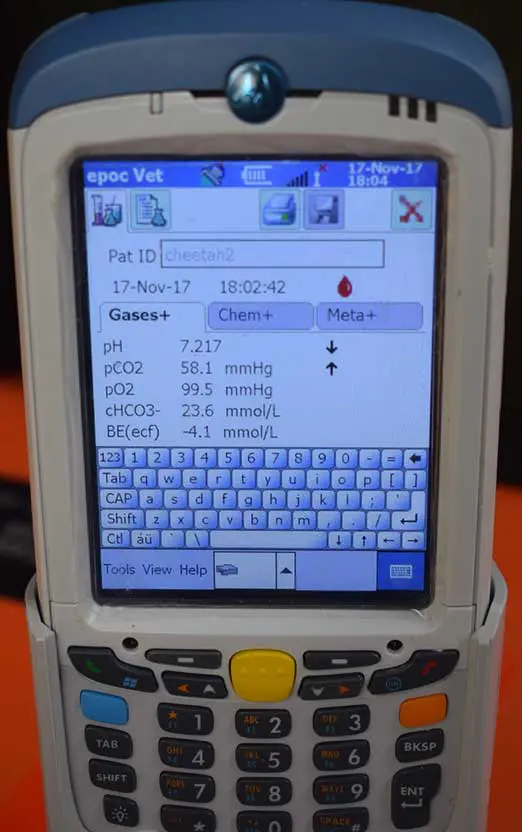
Metabolic alkalosis is reflected as a primary increase in [HCO3–], which consumes H+. High [HCO3–] will result in a high pH. The CO2 will be normal (uncompensating) or high (compensating hypoventilation).
Metabolic alkalosis is fairly uncommon, and it usually has an iatrogenic cause, including inappropriate fluids choices, or by administering bicarbonate.
Essentially, two different non-iatrogenic causes of metabolic alkalosis exist.
In the case of hypovolaemia, the resulting stimulation of aldosterone secretion acts on the distal nephron to stimulate Na+ absorption and K+ secretion. Normally, H+ secretion is not affected, but if [K+] is low, aldosterone stimulates secretion of H+ (ion exchange for Na+).
In cases of loss of acid, this is accompanied by the loss of chloride – so, animals with metabolic alkalosis are often hypochloraemic.
Respiratory acidosis is simply due to an increase in pCO2. Respiratory acidosis is equivocal to hypoventilation, if changes to pulmonary circulation are not involved. High pCO2 will result in a low pH because of the generation of carbonic acid. The [HCO3–] will be high (uncompensating) or normal (compensating). Respiratory acidosis can be primary, or a physiological attempt to compensate for metabolic alkalosis. Primary respiratory acidosis is caused by an imbalance: more CO2 is produced from metabolism than is being eliminated by the lungs.
Respiratory alkalosis is hyperventilation, an increase in CO2 elimination. Decreased CO2 production is not clinically relevant. Low CO2 will result in a high pH. The [HCO3–] will be normal (uncompensating) or low (compensating). Respiratory alkalosis can be primary, or an attempt to compensate for metabolic acidosis. Hyperventilation may be due to central stimulation (anxiety, fever, pain or rarely, brain injury), lung disease resulting in hypoxaemia, parenchymal disease, airway inflammation or overzealous mechanical ventilation. Clinical consequences of respiratory alkalosis are uncommon – it is nevertheless important to find and treat the cause of the hyperventilation.
In general, pCO2 and [HCO3] change towards the same direction in all simple disorders. In dogs, a mixed respiratory-metabolic acid-base disorder is present whenever pCO2 and [HCO3] are changing in opposite directions – one increases and the other decreases (de Caro Carella and de Morais, 2017).
A stepwise approach is used to estimate compensation in acid-base disorders (which is easier to do in dogs than in cats), and readers are referred to the extremely informative and seminal paper by de Caro Carella and de Morais (de Caro Carella and de Morais, 2017).
Given the variety of different causes of metabolic disorders, more than one process could be influencing the metabolic component simultaneously. These are known as mixed metabolic disorders (de Morais and Leisewitz, 2011).
In mixed disorders, the HCO3– concentration may be misleading, and the presence of any abnormality in HCO3– concentration requires further investigation. In addition to examining the HCO3– concentration, venous blood can be used to calculate the anion gap and compare it to the normal anion gap estimated from albumin and P04. In humans, if the HCO3– concentration is less than 22mEq/L or more than 26mEq/L, or the anion gap (-A) is more than 2mEq/L, or if clinical suspicion for a mixed disorder exists, arterial blood should be sampled for a blood gas analysis to provide information on the pH, PaCO2 and SBE.
In patients with acidaemia, the next step is to examine the anion gap (which should be examined even in patients with alkalaemia because of a possible occult metabolic acidosis).
If unmeasured anions are detected, it is a good idea to compare their amounts to the abnormality in SBE; for example, if the calculated anion gap is 5mEq/L greater than the estimated A- and the SBE is -15mEq/L, a mixed metabolic acidosis is present. The unmeasured anions account for a SBE of -5mEq/L, while some other process is responsible for another 10mEq/L. If anion gap is A-, then SIG is close to zero and the cause of the acidosis must be one (or more) of the measured ions. A look at the anion gap (or SIG) and the ratio between sodium to chloride (to see if the patient is normochloraemic or hyperchloraemic) can help to determine if more than one metabolic process is presenting simultaneously. The quantitative approach has the added ease of ability to determine the absolute size of each effect in mmol/L, and a simplified quantitative approach as described by Story (2016) to characterise acid-base disorders is an approach with particularly valuable clinical utility in enhancing understanding of the patient’s acid-base condition.
For the traditional approaches to acid-base interpretation, the author gratefully acknowledges the teachings of Sarah Haldane and Trudi McAlees (both veterinary specialists in emergency and critical care medicine), which generated many important foundations for structuring this article.
Any errors, omissions or misinterpretations that may arise are solely those of the author. Any clinical application of information contained within this article is undertaken at the risk and responsibility of the reader. Acid-base physio-chemistry and its relationship with wider facets of homeostasis are complex, and for the most authoritative, definitive, comprehensive and integrated understanding of acid-base interpretation using or combining different analytical approaches in human medicine, readers are encouraged to refer to contributions by authors such as Forni, Kellum, Morgan, Story and others, seminal papers of which appear in the reference list.
Nigel Dougherty is a Kenya citizen who works as a wildlife and emergency and critical care veterinarian and zoologist. He is the author of Wild Vet Walkabout, an illustrated veterinary travelogue, and 50% of the book’s sales profits will be donated to the veterinary work of the David Sheldrick Wildlife Trust.