14 Apr 2026
Officials said US Congress ‘must act’ to address rural workforce shortages and ensure continued veterinary access to xylazine.

Chris Simpson
Job Title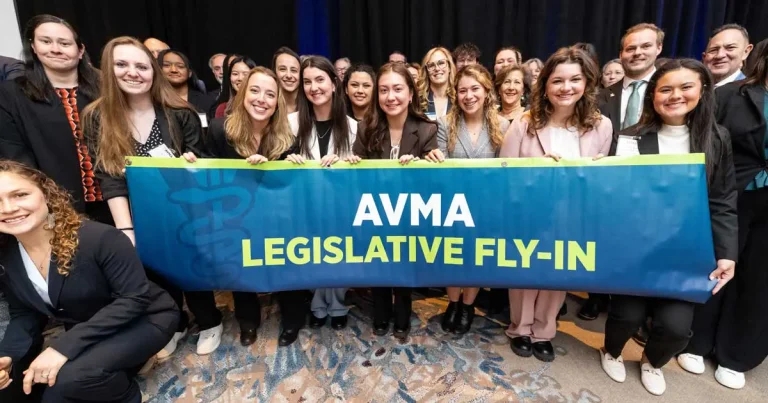
Vets from across the US flew in to raise awareness of the bills. Image credit: AVMA
Congress was told it “cannot afford to wait” to pass key veterinary legislation when more than 100 veterinary professionals met lawmakers in Washington DC.
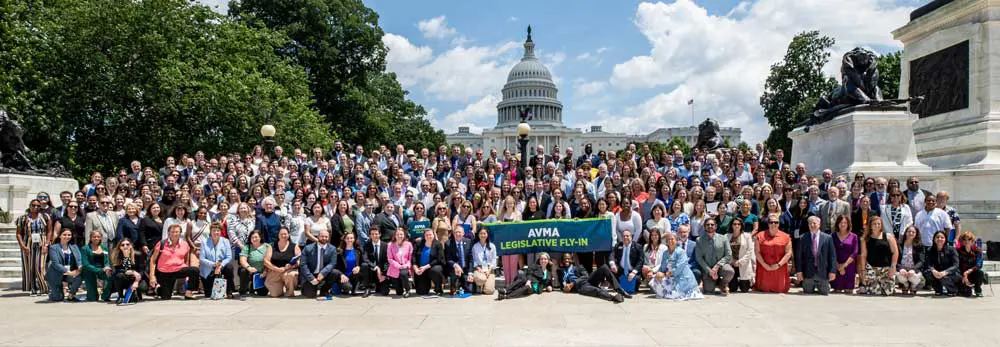
The American Veterinary Medical Association (AVMA)-led fly-in event saw a total of 122 veterinary professionals and students from 36 states, the District of Columbia, Puerto Rico and 21 veterinary schools descended on Capitol Hill.
They participated in almost 150 congressional meetings with lawmakers, urging Congress to advance the bipartisan Rural Veterinary Workforce Act and Combating Illicit Xylazine Act.
The former would eliminate the federal tax burden on awards from the Veterinary Medicine Loan Repayment Program, which provides up to US$40,000 per year in student loan repayment for vets serving in US Department of Agriculture (USDA)‑designated shortage areas.
In 2025, 82% of US vets graduated with an average educational debt of more than US$212,000, while in 2026 the USDA has declared a record 245 veterinary shortage areas across 47 states.
AVMA president Michael Bailey said: “We must strengthen the veterinary pipeline in our rural and underserved communities.
“By passing the Rural Veterinary Workforce Act, Congress can help solve this longstanding challenge and ensure underserved communities no longer go without veterinary care.
“The growing number of designated areas with inadequate access to the essential services of a veterinarian is alarming. We cannot afford to wait. Congress must act to support the future of veterinary medicine.”
Speaking on an episode of the Vet Times Podcast, Dr Bailey added: “[Student debts are] large sums of money, and when you’re being a rural veterinarian having to travel, let’s say, an hour-and-a-half in between calls, it makes it very difficult to be able to repay that, raise a family, maybe even have a home.”
Dr Bailey said the AVMA was urging officials to bring vets into parity with human health care, citing a similar programme for doctors that was not taxed.
He concluded: “We’re trying to make sure that people realise without veterinary medicine, you do not have food security.”
Meanwhile, the Combating Illicit Xylazine Act would strengthen the nation’s response to illicit xylazine – which is being mixed with fentanyl and other narcotics – but protect veterinary access to the sedative.
Dr Bailey described the legislation as “a balanced approach” to the issue, adding: “With broad support of veterinarians nationwide, we urge Congress to pass this legislation. It is vital that our veterinarians, farmers, and ranchers retain access to xylazine for the safe handling and humane treatment of animals.”
He told the Vet Times Podcast that 27 states had thus far put legislation in place controlling xylazine distribution and cautioned against the “domino effects” of bans restricting veterinary access and a “patchwork” of rules making it “confusing” to cross state lines.
He added: “We’re talking about a shortage of veterinarians – if we’re going to make it so that a veterinarian has to know the intricacies of every state they cross into so they can practise and work with animals, it’s going to make it even more difficult.
“The federal legislation is necessary to try and have a uniform ruling so that everybody knows this is how it’s going to be done.
“If it’s illegally being used, we completely support doing what’s necessary, but please just allow veterinarians have access to the form that we are using.”