
7 Aug 2026
Committee chair says removing parasiticides from pet health plans is “the number one thing” she’d like to see from vets.

Chris Simpson
Job Title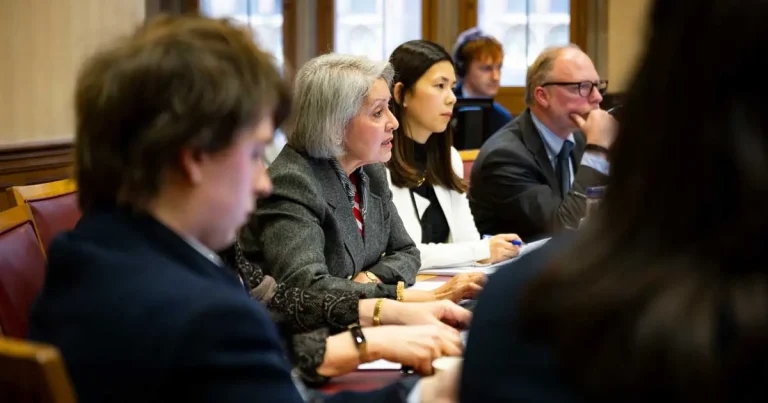
Baroness Sheehan (centre) chairing a meeting of the House of Lords Environment and Climate Change Committee. Image: © House of Lords 2025
A House of Lords report on pet parasite medications (PPMs) usage and their impact on the environment has prompted fresh calls for them to be removed from pet health care plans.
Issued by the Environment and Climate Change Committee, the report called for a ban on the general sale of PPMs, arguing their “intensive and unnecessary overuse… is not supported by robust scientific evidence” and “potentially causing widespread damage”.
Chair Baroness Sheehan, who likened PPM overuse on pets to “using a sledgehammer to crack a nut”, said: “The number one thing I’d like to see vets in practice doing is remove these PPMs from their monthly subscription lists for animal health products.”
She added: “We don’t need to be using these substances routinely is really, I hope, [the] message vets will hear loud and clear. I think vets know this.”
The committee heard evidence subscription schemes create “blanket treatment” regimens, “normalise” routine PPM use and “profit is a primary driver” of PPM overuse.
The report made multiple recommendations, including an interim marketing authorisation change and requirement PPMs are supplied with individualised risk-based advice, while research is done to fill “substantial” evidence gaps on parasite prevalence and PPMs’ environmental impact.
Andrew Prentis, visiting researcher at the Grantham Institute at Imperial College and PREPP (Producing Rational Evidence for Parasiticide Prescription) member, agreed “there absolutely should be a decoupling” of PPMs from health plans.
He continued: “We’re handing out [PPMs] like sweets, just because somebody signed up for a membership scheme… very unprofessional, not evidence-based, unacceptable, environmentally damaging.”
Dr Prentis urged clinicians to use PPMs “in exactly the way we use antibiotics, with exactly the same amount of care and concern” and “restrict the usage, only use them when they’re absolutely needed”.
Overall, Dr Prentis said he was “absolutely delighted” with the report, concluding: “I think it’s a good day for the veterinary profession, it’s a good day for the pets we look after, good day for the environment.”
BVA senior vice-president Elizabeth Mullineaux, who gave oral evidence, said it was “positive” to see the report’s recommendations and said the association supports the call to ban general sale of PPMs.
But NOAH deputy chief executive Donal Murphy argued: “Having accessible products, including the general sale category, remains important in our view, and it should be retained.”
He said PPMs “are essential for animal health and welfare” but “could end up almost becoming a victim of their own success”.
On their inclusion in health plans, he said: “A lot of veterinary practices are looking closely at the plans they have and looking to ensure they are not based on products simply being dispensed on a monthly basis with no proper oversight.
“I would want to give a very clear message that the industry is not saying these products should be used on a blanket ongoing basis prophylactically, with no thought being given to whether they are needed or not.”
He continued: “Antiparasitics are different from antibiotics, and I do think that it is appropriate to treat pets preventively with antiparasitics, subject to there being an assessment of their lifestyle and their risk.”
Using his own dog who frequents wooded areas as an example, he added: “I have treated him prophylactically, so [ticks] don’t attach and they die.
“I don’t think it would be appropriate for my dog, for example, for me to wait for him to have ticks attached before I treat him.”